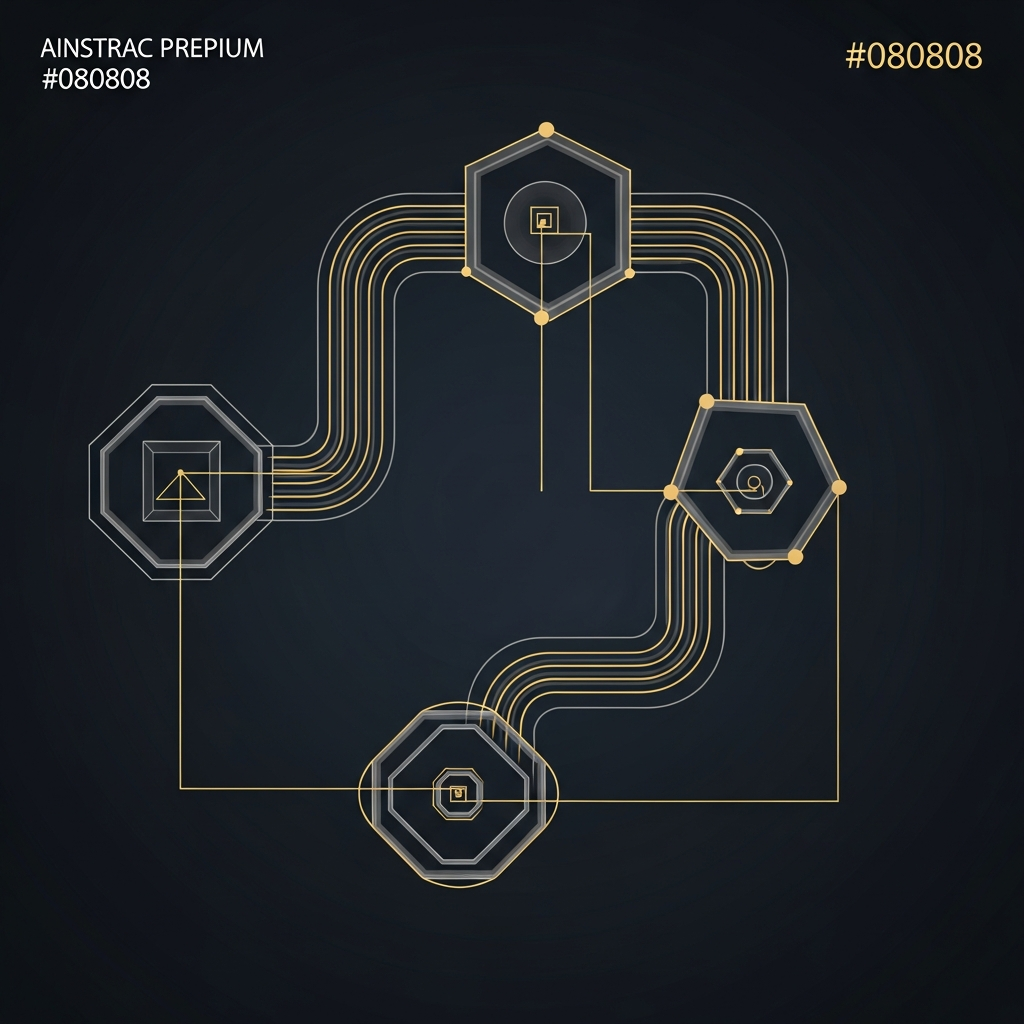
The SidRatnam Architecture
The architecture behind outcomes, not software
How the whole system is put together — the operating model, the capability layer, the evidence chain, the autonomous operations, and the ABT protocol that governs what happens to personal data inside an AI-agent transaction.
The short answer
SidRatnam.com is not a bag of SaaS products bolted together. It is an outcome-driven operating system for real businesses: the technology is the mechanism behind an operator-led engagement where clients buy results — more revenue, lower fees, fewer missed calls — never "a connector" or "an API".
Underneath that promise sit five load-bearing ideas: an operating loop that runs from problem to measured result, a capability layer built once and configured per property, an evidence chain that records what actually happened, autonomous operations held inside bounded authority, and the ABT protocol. This page is the map to all five.
- Capability is centralized and built once; data and execution stay with each property it runs for.
- Every state that matters is written to a hash-chained, tamper-evident evidence chain — evidence, not inference.
- The self-healing layer repairs failures behind gates; anything touching money or orders stops for a human.
- Git and production are kept in sync: clone, change, test, then deploy — the deploy verifies itself or rolls back.
The operating model
One loop, run end to end
Every engagement moves along the same spine. It starts at the business problem and does not finish until the result has been measured and the system has learned something it keeps.
Problem
The real business problem, in the owner’s words — captured by an operator, not a form.
Outcome
What “better” actually means here, stated as a result the business wants.
Gap
The distance between the current state and that outcome — verified, never assumed.
Solution → Capability
The solution shape, and the reusable capability that delivers it.
Implementation
The capability activated and configured on the property’s own infrastructure.
Result → Evidence
What happened, written to the evidence chain as a durable, checkable record.
KPI → Outcome
Measured against the exact numbers agreed in advance — outcomes, not activity.
Learning
What the result teaches, fed back so the next engagement starts further ahead.
Clients pay for the outcome, not the service: discovery is free, the written proposal is free, and execution is priced against the KPIs agreed together. The three steps are set out on the How We Work page.
Platform · Property · Capability
Build the capability once. Run it where the business lives.
The hardest line in the whole system is the one between what is shared and what is owned. SidRatnam.com owns and versions the capabilities; each property owns its data, its runtime and its customers. "Build once, configure many times" means building the capability at the platform layer and activating it per property — never pulling a property's transactions into the centre.
Capability — centralized
SidRatnam.com builds, owns, versions, configures and governs the reusable capability. One definition, many activations.
Data & execution — property-local
Each property — its own database, runtime, customers, payments and consent records — runs independently. A central service going down never breaks a property's checkout.
Administration — a read surface
The centre aggregates over authorized per-property read APIs. It is a view and a control plane, never the owner of the business data.
A capability is distinct from a solution and from an implementation: the solution is the outcome-shaped engagement, the capability is the reusable mechanism, and the implementation is the property-local deployment that actually runs. They are composable and event-driven, which is what lets the same capability serve many properties without any two of them sharing data.
The Evidence / Event Chain
Evidence, not inference
Most systems can tell you what they believe is true. This one keeps a record of what actually happened. The Evidence Chain (EEC) is a durable, hash-chained log of the transitions that matter — a capability installed, activated, executed, failed or completed; a client or property moving from one real state to another — with each event cryptographically linked to the one before it.
Hash-chained
Each event is hashed (SHA-256 over its core fields) and carries the previous event's hash, so the history is tamper-evident and can be verified forward from the very first event.
Signal, not noise
It is deliberately narrower than ordinary logging. Logins and page views do not belong in it. Only business-state and capability-lifecycle transitions — the events a later audit or measurement pass would actually want to reason over — are written.
Provenance attached
An event points at the durable row that is its evidence, so the proof lives next to the claim. The same discipline runs through the public site: every figure carries its source, date, population, and whether it is an observation, an estimate or a projection.
The ABT registry is the public, hash-anchored expression of the same idea: a ledger every ABT deployment is anchored to, from which a boundary violation could be independently established rather than relying on an organisation's own internal logs.
Autonomous operations, bounded authority
A system that fixes itself — inside hard limits
Autonomy here is defined by its guardrails, not by an off-switch. The estate runs a self-healing layer and a continuous intelligence layer, and both are held inside bounded authority: there are things they do automatically, and a sharp line past which they stop and ask a human.
The Error Agent repairs
When something fails, the self-healing layer attempts a real, verified fix — not just a work order. It writes a failing test first, the author is never its own verifier, and the change is verified in production and rolled back if it regresses.
Money and orders stop for a human
Anything touching payments or order fulfilment is blocked for human decision. Bounded authority means the system is trusted exactly as far as its gates allow, and no further.
Measured, not watched-over
An operating-intelligence layer measures the estate on a timer and records only the transitions to the evidence chain — so a problem surfaces proactively, and an unmeasured signal is never reported as healthy.
Maintenance and health, recovery readiness, and the self-healing layer are the operational face of this. Security Assurance is where a business can see that discipline applied to its own infrastructure — a tested, rehearsed, measured recovery, so the recovery time is known before the incident.
Isolation, deployment & rollback
How a change reaches production safely
Properties are isolated from one another, and every change arrives by a route that was tested first. The rule is simple and absolute: git and production stay in sync.
Property isolation
No property reaches another property’s data; each runs its own database, runtime and payment integration.
Clone, don’t patch
Changes are made in a clone of the running system, never hand-edited in place on the live server.
Test in the clone
The change is proven in the clone before anything is shipped.
Deploy only what changed
Only the intended paths ship; everything else on the server is left exactly as it is.
Verify or roll back
The deploy checks the live pages over HTTPS for a real response, and rolls back from a backup if anything fails.
These two hub pages were published exactly this way: generated from the site’s own build data, dry-run first, then deployed additively and verified live.
The ABT protocol family
What happens to personal data inside an AI-agent transaction
ABT — Agentic Boundary Tokenization — is a patent-pending protocol invented by Sid Ratnam (U.S. Provisional Patent 64/056,353, filed 4 May 2026). It establishes, cryptographically and per transaction, the boundary around what a system may see: what can be revealed, for what purpose, under what authorization, and for how long. It is not a competitor to the agent-commerce protocols that move the transaction — it governs the personal data inside it, and it stacks with them.
One foundational architecture
Every variant inherits the same envelope-tier design: first-party-side encryption on the consumer's device, callback-mediated key release, per-tier projections, registry-routed lifecycle, and forward-only tier activation. Plaintext never traverses the network.
The boundary sits at the device
Personal data is encrypted in hardware-backed storage before any ciphertext leaves the device. The merchant holds ciphertext and a callback URL, never plaintext; retention is enforced by the device ceasing to release keys, not by a promise to delete.
Ten domains, one deployed
The family spans commerce, identity, medical, voting, warrants, records and more. ABT-C, the commerce variant, is commercially deployed today at cinematiccard.com and verified across 50+ scenarios. SidRatnam.com is the only party certified to deploy ABT.
The variants build on one another from the protocol foundation outward:
ABT — the protocol
The foundational specification, the three-party mechanism, and how ABT stacks with ACP, AP2 and UCP.
ABT-A — Authority Tokenization
How authority to act is established and scoped within the protocol.
ABT-B — Business Server Protocol
How a business node registers, announces capabilities and exchanges evidence.
ABT-C — Agentic Commerce
The live, commercially deployed commerce variant. Consumer-side encryption for AI-agent purchases.
ABT Registry
The public hash-anchored ledger of every ABT deployment, per variant.
Agentic Commerce
Making a business discoverable and transactable by AI shopping agents, on infrastructure it owns.
Where to go next
The rest of the body of work
The AI Business Guide
How AI and modern operating approaches apply to a real business.
Outcomes Matter
Five business outcomes and the specific problems beneath them.
About
The philosophy behind everything built here: purpose before technology, privacy by design, automation with accountability.
How We Work
Free discovery, free proposal, execution tied to your KPIs.
Put the architecture to work on your business
The free analysis looks at your actual business and comes back with a short list of opportunities, ranked by what they would genuinely be worth to you.