
The invisible decline
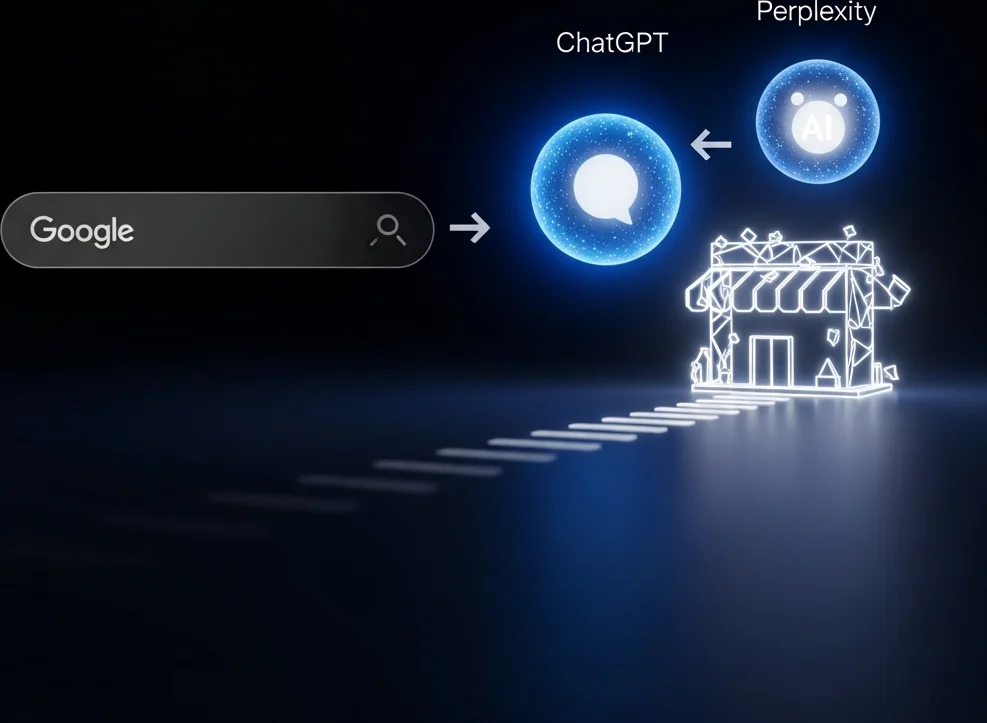
Google clicks have been flat or declining for a growing number of stores — stores that changed nothing about their SEO, published no fewer pages, lost no rankings. The explanation is structural: when people ask their AI assistant instead of typing into Google, the search query never happens. The click never happens. The session never registers in your analytics. The traffic evaporates without leaving a trace of where it went.
Where it went is to stores that are agent-ready. ChatGPT, Operator, and Perplexity Comet are routing purchases directly to stores that have deployed the Agentic Commerce Protocol (ACP) — a discovery file, a purchase endpoint, machine-readable product data. Stores without that infrastructure are invisible to AI agent traffic the same way a store with no sitemap is invisible to Google. The agents skip them and route to the next store that can actually serve them.
This is not a prediction. It is the mechanism that is already running. Google's AP2 (Agent Payments Protocol) is the next standard on the roadmap — not yet deployed, but the direction is set. Stores building ACP compliance now have a structural head start when AP2 ships because the underlying infrastructure is the same foundation both protocols require.
Two levers. Both on your infrastructure.
Agentic commerce and SEO interact in two distinct ways — and confusing them leads to the wrong build. The first is behavioral: commerce agents improve the session signals that search engines read as quality. The second is generative: JARVIS, the Autonomous SEO Self-Ranking System, runs an autonomous content pipeline that captures organic search as owned infrastructure.
Both levers run on the VPS you control — Hostinger, GoDaddy, DigitalOcean, Vultr, SiteGround, or any VPS with root access. Both compound over time. Neither requires a SaaS subscription to keep running.
Lever one: behavioral signals
Google's ranking systems have increasingly weighted user experience data — dwell time, scroll depth, return visit rate, click-through behavior — as proxies for content quality. Commerce agents change those signals at the session level.
Dwell time increases. When a product discovery agent surfaces the right product at the right moment, visitors engage with content that is actually relevant to them. They stay and explore rather than leaving to refine the search. Longer average sessions across your domain signal quality.
Bounce rate decreases. Cart recovery agents and checkout intelligence reduce the proportion of sessions that end without meaningful engagement. A visitor who abandons, receives a contextually accurate recovery message, returns, and converts produces an extremely high engagement signal.
Return visit rate increases. Post-purchase agents that run effective onboarding sequences, review prompts, and LTV expansion flows bring customers back. Return visits weight more heavily than first-time visits in quality assessment.
These effects are real and measurable — but they are downstream of traffic that already exists. Agents improve what visits produce. They do not generate the visits themselves. That is lever two's job.


Lever two: JARVIS as your direct SEO engine
JARVIS is the direct lever. Alongside the commerce monitoring layer, JARVIS runs an autonomous content pipeline: it generates SEO-targeted articles from your site's topic architecture, publishes them to your blog, updates your sitemap, and submits new URLs to Google's Indexing API within hours of publication.
This is not a content tool you log into. It is infrastructure that runs on your server — whether that is Hostinger, GoDaddy, DigitalOcean, Vultr, Bluehost, Contabo, Hetzner, or any VPS with root access. It generates articles on your domain, builds organic authority you own outright, and costs nothing to keep running beyond your server. No monthly seat cost. No content agency on retainer. No tool that disappears when you stop paying. The articles exist in your repository, indexed under your domain, generating traffic for as long as the domain is live.
The operational cost is approximately $0.001 per article in AI inference — fractions of a cent per generation. The pipeline runs on a schedule: JARVIS generates, publishes, and submits without a human in the loop.
Organic search is the only traffic channel that compounds as an asset. JARVIS does not generate traffic the way a paid campaign does — it builds a body of owned content that keeps earning clicks long after the work is done.


The combination effect
Running both together produces a flywheel that neither creates alone. JARVIS generates articles that rank for relevant queries and bring visitors to the store. Commerce agents ensure those visitors convert, stay, and return — producing the behavioral signals that strengthen the organic rankings that brought them in.
Commerce without SEO: you are optimizing traffic you pay for. Every visitor costs money; the agents help them convert better, but the channel itself does not compound.
SEO without commerce optimization: you are generating organic visits that underperform at conversion. The traffic is cheap; the leakage is expensive.
Both together: organic visits land on a store built to convert them, generating behavioral signal that reinforces the rankings that produced the visits. This is how the infrastructure compounds.

What each package covers
Foundation ($5,000) — One commerce agent for one specific problem. Behavioral signals improve in the agent's coverage area. The right start when you have a defined, acute conversion problem and want to prove the model before expanding.
JARVIS Suite ($20,000) — The complete autonomous system: JARVIS running 89 daily tasks across SEO, content, social, and security, plus four commerce agents covering the entire customer lifecycle. Built to maximize the value of traffic you already have.
JARVIS Suite ($20,000) — The complete stack: JARVIS running autonomously every day (SEO, content, social, security, backups, morning reports) plus four commerce agents driving conversion. Agents that convert traffic and an autonomous pipeline that generates it.
BUILD FOR YOUR STORE
Own the traffic.
Own the conversion.
Foundation: no payment until your agents are live and working on your server. Applications take 10 minutes. Response within 48 hours.
Apply for a build → ← Back to Agentic Commerce overview