
How one sentence becomes a transaction

A person says to their AI: "I want my favourite coffee." The agent knows their preference — flat white, oat milk, from the same place they ordered last week. It looks up that store. Checks whether the store has an agent-readable endpoint. Finds the product. Evaluates the price against what they paid before. Places the order. Handles payment through Stripe. Sends a confirmation.
The person is still mid-conversation. They did not open a browser. They did not type into a search bar. They did not browse anything. They issued one instruction to an AI that had the infrastructure it needed to complete a real transaction — and the store got a sale it never touched.
That is agentic commerce. Not a better checkout page. Not a smarter recommendation widget. A complete purchase, initiated and completed by an AI acting on a user's behalf, against infrastructure the store controls. The stores that have that infrastructure get the sale. The stores that don't are invisible to this traffic channel entirely.
The word "agentic" is doing real work
An AI that answers is reactive. It waits for a question. An agent is proactive — it monitors signals, makes decisions, and takes actions. The coffee example shows the difference clearly: the AI did not answer "where can I get coffee?" with a list of options. It completed the purchase. That is a fundamentally different capability, and it is what stores either have infrastructure for or do not.
ChatGPT, Operator, and Perplexity Comet are already executing purchases on behalf of users. They use the Agentic Commerce Protocol (ACP) — a joint specification from OpenAI and Stripe — to identify which stores can serve them. Stores without ACP infrastructure are invisible to this traffic channel the same way a store with no sitemap is invisible to Google.
The four places agents act in a commerce stack

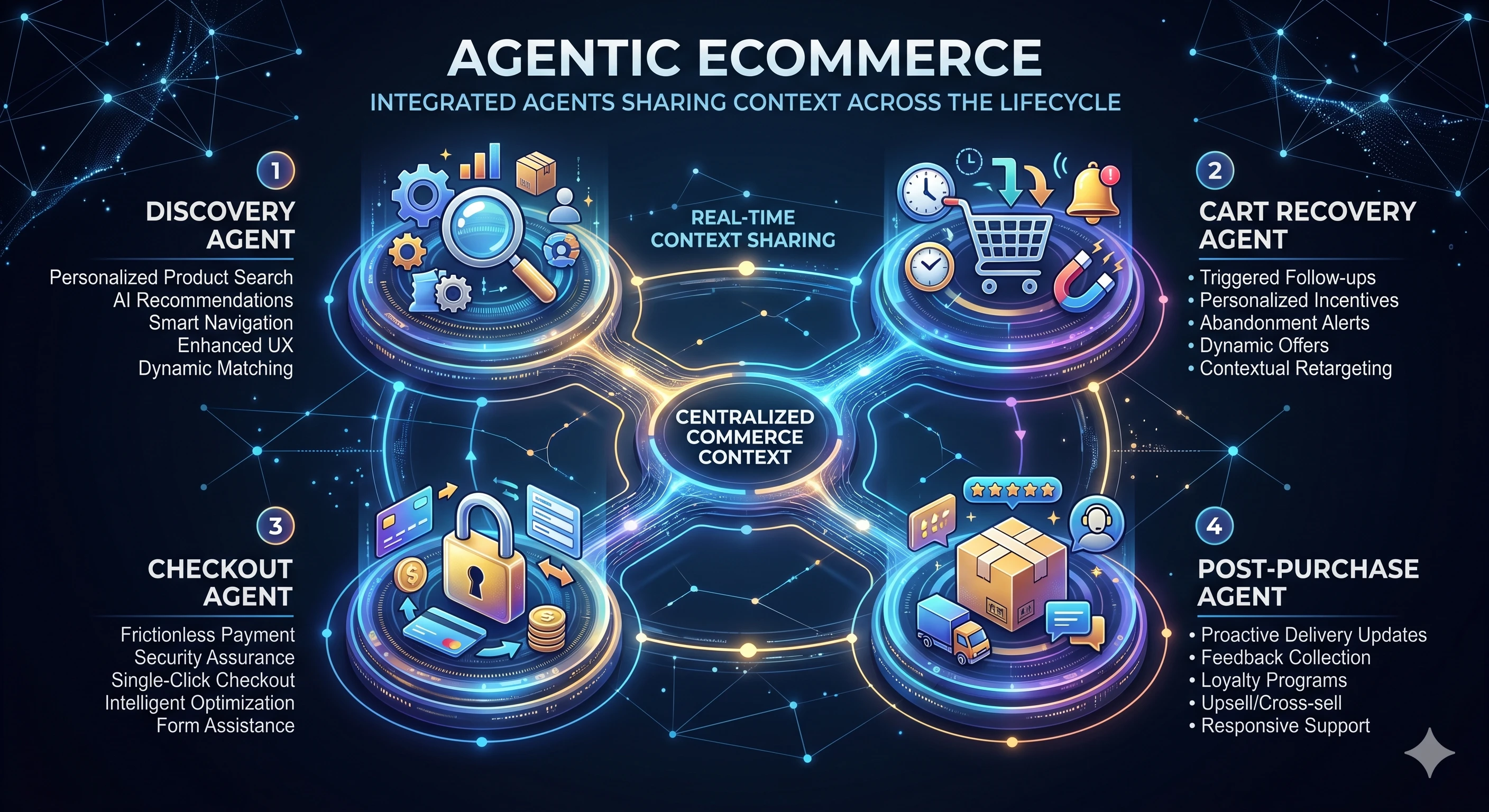
The commerce lifecycle has four stages where agents generate measurable return when built correctly:





What makes this different from a SaaS tool
The standard approach to each of these problems is to buy a SaaS tool — Klaviyo for email, Rebuy for recommendations, CartHook for checkout, Gorgias for support. Each tool does its specific job passably. None of them talk to each other. The recovery email does not know what the checkout agent learned. The recommendation widget does not know what the recovery sequence triggered. The post-purchase flow does not know the customer's session history from before the sale.
Agents built for a specific store share context across the lifecycle. The discovery agent and the checkout agent run on the same session data. The recovery agent knows what the checkout agent logged. The post-purchase agent knows what the customer's full journey looked like before they converted. That shared context is what makes the actions intelligent rather than just automated.
The second difference is ownership. SaaS tools are rented. If the vendor raises prices, deprecates a feature, or goes under, the capability leaves with them. Agentic commerce built as custom code is owned — it runs on infrastructure you control, it is in your repository, and it continues to work regardless of what happens to any third-party vendor.
What agentic commerce is not
Three things people assume this is. None of them are correct.


Five protocols. One complete stack.
Agent-readiness is not one checkbox. It is five distinct layers of infrastructure, each covering a different part of how AI agents find, read, and transact with your store. The Foundation build deploys all five. You don't need to understand all of them — but you should know what you're getting.
ACP — Agentic Commerce Protocol
The standard OpenAI and Stripe deployed in 2025. Defines how AI shopping agents — ChatGPT Operator, Perplexity Comet — discover stores and complete purchases. Implemented via a discovery file at /.well-known/agent-purchase.json and a purchase backend. Stores without ACP are invisible to this channel the same way a store with no sitemap is invisible to Google.
AP2 — Agent Payments Protocol
Google's forthcoming standard for the same problem — AI agents authorizing and completing payments without a human-operated checkout. Not yet deployed, but the direction is set. Stores built to ACP now have a structural head start because the underlying infrastructure is the same foundation AP2 builds on.
UCP MCP — Model Context Protocol
Anthropic's standard for exposing store capabilities directly to AI models like Claude. MCP allows agents to read your catalog, check inventory, and execute actions through a structured server interface — not just a web scrape. As the Claude ecosystem grows, MCP-ready stores gain a direct channel to Anthropic's agent network.
A2A — Agent-to-Agent Protocol
Google's emerging standard for AI agents communicating with each other — enabling one agent to delegate tasks to another. In a commerce context, a personal shopping agent can coordinate with a store's inventory agent, a logistics agent, and a payment agent simultaneously. A2A is the layer that makes multi-agent commerce transactions possible.
ABT-C — Agent Behavioral Trust · Commerce
The trust and behavioral audit layer that sits above all four protocols. ABT-C v2 tracks and certifies every AI agent interaction — what the agent did, what it was authorized to do, and how the transaction was verified. It gives merchants a cryptographic audit trail of agent commerce activity that no other infrastructure provides. This protocol is exclusively available here. Not in any SaaS platform. Not from any other operator.
Who is building it and who needs it
The businesses that benefit most from agentic commerce are stores with real transaction volume — $10,000/month and up — where the gap between current revenue and achievable revenue is measurable, and where the bottleneck is not traffic or product but conversion, retention, or post-purchase economics.
The stores that do not benefit yet are pre-launch or early-stage — there is no behavioral data to work with, no abandonment patterns to analyze, no checkout friction to instrument. Agents need signal to act on. Build the store first.
If your store is generating revenue and you know specifically where the leak is, that is the problem agentic commerce solves. The build starts with a clear use case and produces working infrastructure at the end of it.
READY TO BUILD
Agentic commerce,
built for your store.
Foundation builds start at $5,000 — no payment until your agents are live and working on your server. JARVIS Suite at $20,000. Applications take 10 minutes. Response within 48 hours.
Apply for a build → ← Back to Agentic Commerce overview