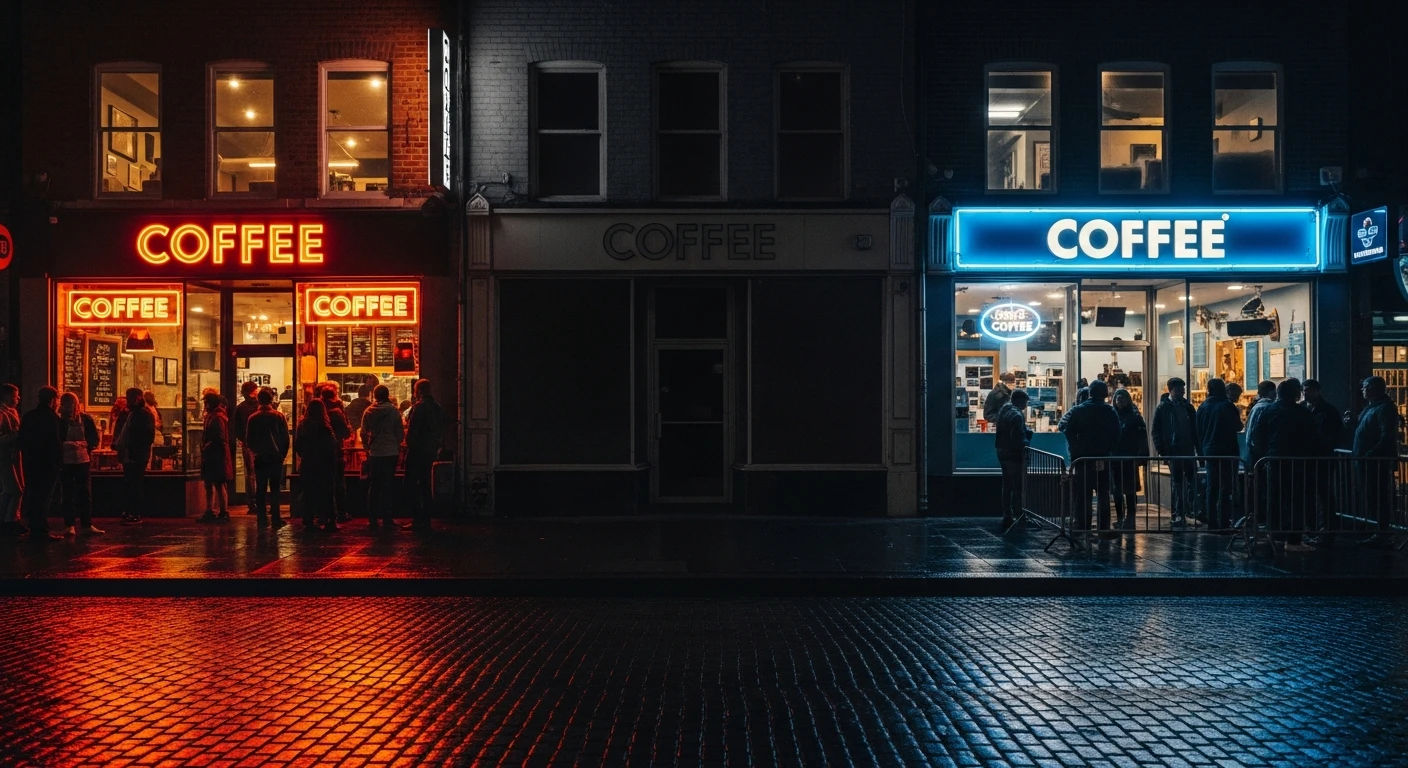
It didn’t close. The coffee didn’t change. The location didn’t move.
An AI simply stopped knowing it was there.
The moment it happened.
A customer opens ChatGPT and says: “Order my usual coffee.”
ChatGPT pulls up three coffee shops nearby. Two of them are ACP-compliant — they exposed their menu, their inventory, their checkout to AI agents months ago. One isn’t.
ChatGPT shows the customer the two ready ones. The agent routes the order. The customer gets their coffee without looking up from their screen.
The third coffee shop — the one that’s been there for eight years, with the best cold brew on the block — never appears.
The third coffee shop didn’t lose the customer.
They are now simply invisible.
The customer walked over and picked up their order from one of the two visible shops. They had no idea there was a third option. The agent never saw its menu. There was no chance to compete.
This is not a forecast.
ChatGPT now reaches 900 million weekly users. Customers arriving at stores through ChatGPT convert 31% higher than those arriving through unbranded Google organic search — measured across 94 e-commerce brands over twelve months.
Customers routed through AI convert at 1.7 times the rate of those from Google — 12% versus 7%, with 11% higher average order value. By some measures, AI-referred shoppers convert up to 23× higher than traditional organic search traffic.
The infrastructure is not coming. It is here.
OpenAI launched the Agentic Commerce Protocol in March 2026. Target, Sephora, Nordstrom, Lowe’s, Best Buy, The Home Depot, and Wayfair are already integrated. They exposed their inventory, their checkout, and their fulfillment to AI agents before this was common knowledge. They are the first storefronts in the corridor with the lights on.
Most stores are still the third coffee shop. The lights are off. The agents pass them. The customers never know they were there.
The cost of waiting is becoming invisible.
Every quarter you wait, your competitors who shipped early become the merchants AI agents reach for by default. Their lead is not because they are better. Their lead is because they were ready first.
Once those preference patterns lock — once an AI has been answering “order coffee” with the same two shops for six months — the third shop doesn’t just lose this order. It loses being part of the consideration model entirely. The AI’s map of the category no longer includes you. Re-entering that map is harder than entering it the first time.
You are early enough that early still means something.
That window is closing.
Make AI agents your best customer.
Your store can be the one AI agents reach for first. Not because of luck. Because you built the infrastructure that makes you visible — and transactable — to them.
AI-agent compatibility requires three layers: a discovery file so agents can find and identify your store, structured purchase data so agents can read your products and prices, and a transaction endpoint so agents can complete purchases without a human in the loop. That is what Agentic Commerce Protocol compliance means. It is not a plugin. It is not a SaaS subscription. It is code installed on your own server, owned by you, running for you permanently.
Your competitor on Shopify is waiting for Shopify’s product team to ship ACP. Your competitor on Squarespace is waiting for Squarespace’s team. They are all waiting for vendor roadmaps controlled by enterprise priorities, on pricing that will eventually take a percentage of every agent-driven transaction forever.
You own the box. You don’t wait.
Proof it is running right now.
Two live stores, both ACP-compliant, both transacting through AI agents today:
-
cinematiccard.com/agents
— digital greeting card purchases. On April 24, 2026 at 9:35 AM ET,
an autonomous AI agent completed a real purchase: a $7.99 Premium birthday card,
paid via Stripe in under one second.
Stripe payment intent:
pi_3TPjsvBNbL5DPyi3177ElaVM. - tradeexecutor.ai/agents — software license sales. ACP-compliant, transacting today.
Both run on the same infrastructure that gets installed for you. Both visible to AI agents right now. The receipts are public.
Not only has it been done. It will be proven live, in front of you, before any money changes hands.
How to get set up. (You don’t pay until you have proof.)
The Foundation install happens live on a Zoom call — under sixty minutes. You watch every step on screen. By the end of the call, your store is ACP-compliant, a real AI agent has completed a real test purchase through your Stripe account in front of you, and access has been deleted from your server while you watch.
You do not pay until you see it working. Invoice is sent after the live test. 72-hour payment window. The system runs without interruption throughout. If it doesn’t pass the live test, there is no invoice.
── the two packages ─────────────────────────────────────────────────
Foundation — $5,000
One ACP agent deployed live on Zoom. Real AI test purchase through your Stripe. Live install in under 60 minutes. Dedicated VIP email for ongoing support. Full code ownership — runs on your VPS. Zero upfront. Pay only after the live test succeeds.
JARVIS Suite — $20,000
An autonomous system running 89 daily tasks — SEO, content, social, security, backups — plus four commerce agents on your VPS. 60-day delivery, ongoing support. Requires Foundation first.
Application takes ten minutes — reviewed personally
Apply for the Foundation build →You don’t pay until it’s proven live
— Sid Ratnam
April 2026